
How to Create Unique Dessert Menus That Sell
by Editorial Team
Quick Summary
To create unique dessert menus that sell, decide first what the menu is for, then build a few signature flavours and balance them across texture, temperature and intensity. Keep a few permanent anchor items, add seasonal options gradually, and price each dessert from its true cost.
- Decide whether your dessert menu is a profit driver, brand statement or meal finisher, and stick to one main job.
- Build signature flavours around pairings such as Chocolate Miso with toasted coconut crumb or Matcha with fruit sorbet.
- Keep one light and one rich option on the menu at all times to give guests real choice.
- Keep three to four permanent anchor desserts and add one or two seasonal options each quarter.
- Work out the cost per portion for each dessert before setting prices and a target food cost percentage.
Table of Contents
- Start With a Clear Idea of Your Dessert Menu's Role
- Build Unique Dessert Ideas for Restaurants Around Signature Flavours
- Balance Your Dessert Menu Across Textures, Temperatures and Flavours
- Plan Seasonal Dessert Menu Ideas Without Overhauling Everything
- Set a Dessert Menu Pricing Strategy That Protects Your Margins
- Present Your Dessert Menu So Guests Actually Order
- Test, Track and Refresh Your Dessert Menu This Season
- Frequently Asked Questions
Start With a Clear Idea of Your Dessert Menu's Role
Last Updated: October 28, 2026
Most restaurants treat dessert as an afterthought. A tired list of three items gets printed once and never touched again. Yet a well-built dessert menu can lift the average bill, give guests a reason to stay longer, and set your venue apart from the place down the road. The menus that sell share one thing, a clear job.
Before you pick a single flavour, decide what your dessert menu is for. Is it a profit driver, a brand statement, or a simple way to finish a meal? Each goal leads to different choices.
Write your answer in one sentence. For example: "Our dessert menu exists to give guests one memorable finish, not a long list to choose from." That sentence becomes your filter for every decision after this. Aligning your selection with the natural rhythm of the harvest ensures that seasonal menu planning remains a core component of your overarching culinary identity.
- Profit driver: Fewer, higher-margin items with strong add-on potential
- Brand statement: Signature items that guests talk about and return for
- Meal finisher: Light, shareable options that suit many diners
Watch out: a menu that tries to do all three usually does none of them well. Pick your main job and let the rest follow.
Build Unique Dessert Ideas for Restaurants Around Signature Flavours
Unique dessert ideas for restaurants usually start with one or two flavours that tell a story.
Asian-inspired flavours give you a strong starting point. Matcha Green Tea, Chocolate Miso and Toasted Coconut each offer a clear point of difference from the usual vanilla and chocolate. Miso adds savoury depth to chocolate, which gives a salted caramel-like finish. Matcha brings earthy, slightly bitter notes that balance sweetness.
Try building a dessert around a flavour pairing rather than a single ingredient:
- Chocolate Miso served with toasted coconut crumb for texture contrast
- Matcha Green Tea paired with a fruit sorbet for a clean, bright finish
- A small tasting plate with three scoops that share a theme
Our Tasting Flight Box (£36.00) contains 12 flavours in 100ml portions and offers a curated selection of East Asian-inspired flavours. It is described as a way for newcomers to experience the range, and as a gift or treat to share with friends and family.
Balance Your Dessert Menu Across Textures, Temperatures and Flavours
A balanced dessert menu gives guests real choice without overwhelming them. Aim for variety across three areas: texture, temperature and flavour intensity.
Texture matters more than many operators expect. A smooth, creamy scoop feels different from a chewy, crisp or crumbly element. Pairing a soft ice cream with a crunchy topping or a chewy component, such as mochi in our Brown Sugar Mochi Ice Cream (£8.50), gives the eye and mouth something to notice.
Temperature gives you another lever. Cold desserts, warm desserts and room-temperature options each suit different occasions.
Flavour intensity works best in pairs. Keep one light, refreshing option and one rich, indulgent option on the menu at all times.
- Light: sorbets and fruit-led desserts
- Rich: chocolate, caramel and dairy-heavy desserts
- Bold: savoury-sweet pairings such as miso or matcha
The article suggests balancing the menu across three areas, which are summarised below.
| Balance area | What to aim for | Example from the article |
|---|---|---|
| Texture | Contrast within the dessert | Soft ice cream with chewy mochi |
| Temperature | Cold, warm and room-temperature options | Cold, warm and room-temperature options suit different occasions |
| Flavour intensity | One light and one rich option at all times | Light: sorbets; Rich: chocolate and caramel |
| Bold pairings | Savoury-sweet combinations | Miso or matcha |
Plan Seasonal Dessert Menu Ideas Without Overhauling Everything
Seasonal changes keep a menu fresh, but a full rebuild every quarter is costly and tiring for your kitchen.
Choose three to four permanent items that guests expect. These are your anchors, the desserts people ask for by name. Then add one or two seasonal options each quarter.
Use your front-of-house team to mention it, and print it on a separate insert so it stands out.
Set a Dessert Menu Pricing Strategy That Protects Your Margins
A dessert menu pricing strategy should cover your ingredient costs, your labour and your target margin.
Start by working out the cost per portion for each dessert, including the scoop, toppings, garnish and packaging. Then decide on a target food cost percentage for dessert.
Keep prices consistent across similar items.
Consider these pricing approaches:
- Anchor pricing: place one premium item at the top to make mid-range options look reasonable
- Bundles: offer a dessert and coffee together at a small saving
- Sharing sizes: a larger shared dessert can raise the average spend per table
Our Chocolate Miso, Matcha Green Tea and Brown Sugar Mochi Ice Cream products are each listed at £8.50.
Present Your Dessert Menu So Guests Actually Order
Place the dessert menu in view as soon as the main course is cleared, or show it with the bill. Use short, descriptive names and one or two lines per item. Describe the taste and texture rather than listing ingredients, such as "dark chocolate with a savoury miso finish" instead of a long component list.
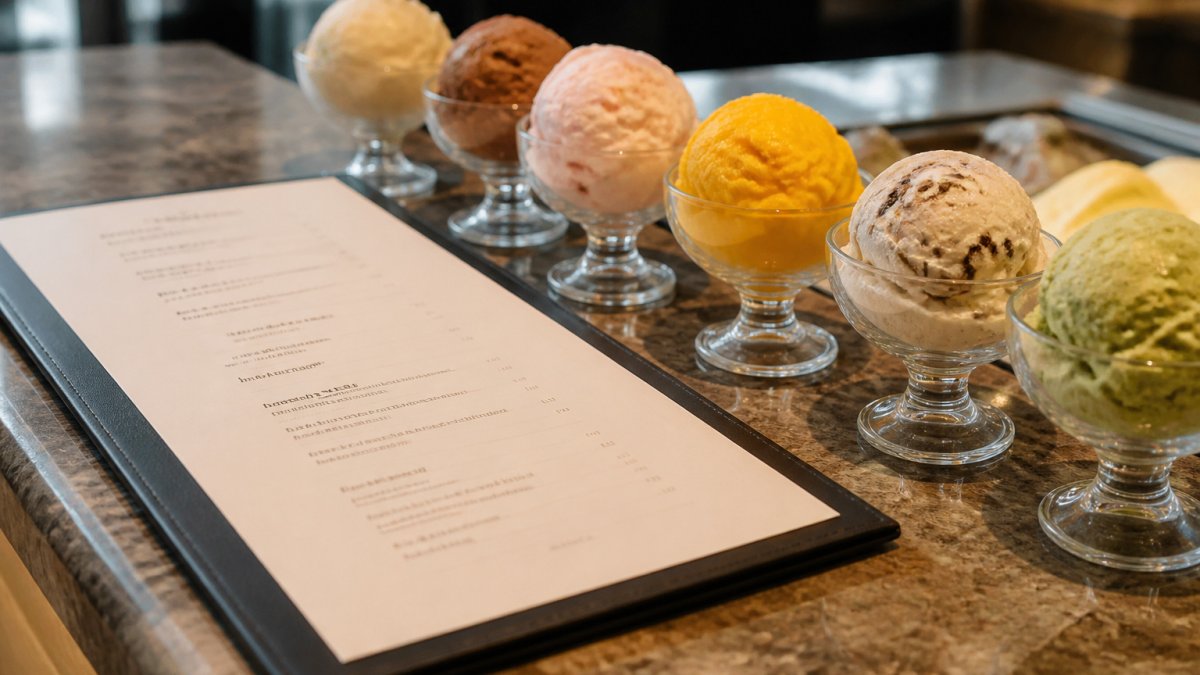
Photography helps when it is clean and honest.
Train your team to describe desserts with confidence.
!Close-up of a neatly printed dessert menu beside a row of scoops in glass dishes on a café counter, warm lighting
Test, Track and Refresh Your Dessert Menu This Season
Track which items sell, which get ordered as add-ons, and which are rarely chosen.
Set a simple review schedule. Once a month, check sales for each item. Once a season, decide which items to keep, change or remove. Ask your team for feedback too, since they hear what guests say at the table.
Test one change at a time. Change a description, move an item to a different spot on the menu, or adjust a price, then compare sales over a set period.
A dessert menu is never finished.
Frequently Asked Questions
How do you create a dessert menu for a restaurant?
Start by deciding what role desserts play for your business: a finishing touch, a reason to return, or a profit centre.
How many desserts should a dessert menu include?
Most independent cafés and restaurants do well with four to six desserts on the permanent menu, plus one or two seasonal specials. Fewer items make ordering easier and reduce freezer and prep pressure, which matters for smaller kitchens with limited storage. Larger groups can extend the range, but each addition should earn its place with clear sales data rather than being added for variety alone.
How should you price desserts on a menu?
Calculate the full cost of each portion, including ingredients, packaging and labour, then set a target food cost percentage.
What makes a dessert menu unique?
A distinctive dessert menu usually combines a clear point of view with flavours guests cannot find elsewhere nearby. Asian-inspired flavours such as matcha, miso or brown sugar mochi can set a menu apart from the usual vanilla and chocolate offer. Pair one or two adventurous options with familiar favourites so cautious customers still feel comfortable ordering. Consistency in quality and presentation helps the menu feel considered rather than random.
